We talk to San Antonio homeowners every week who are outgrowing their homes but love their current neighborhoods.
The decision between an attic conversion vs addition is the first major hurdle. Our team knows this choice completely dictates your budget, timeline, and the level of disruption you will experience.
A ground-floor addition offers a blank canvas, while an attic conversion utilizes your existing roofline for a faster return on investment. We’ll break down the true costs, structural code requirements, and timelines to help you choose the right path. This guide compares the essential factors so you can make an informed decision for your growing family.
Quick answer
Our most direct answer is that an attic conversion is generally cheaper and faster, while a ground-floor addition offers unlimited design flexibility.
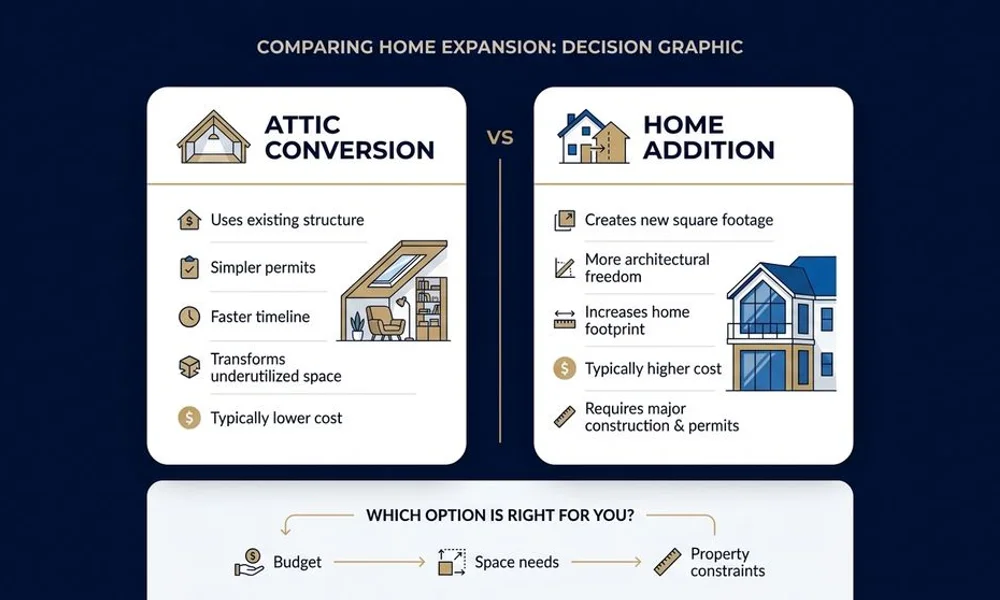
An attic project averages $50 to $150 per square foot, compared to the $125 to $250 per square foot cost of a new room expansion. We urge you to compare structural feasibility, San Antonio headroom regulations, egress codes, and total permitting timelines to determine which option actually fits your property.
The graphic below illustrates the main decision points.
What this guide covers
We outline exactly what you need to know before starting a major space expansion. These four factors determine project viability and final costs.
- Cost: San Antonio pricing models for 2026.
- Structural feasibility: Joist weight limits and foundation checks.
- Headroom and egress: 2021 International Residential Code compliance.
- Timeline and permitting: City of San Antonio Development Services requirements.
Why this matters in San Antonio
Our design-build process is the single biggest fix for the friction homeowners experience during a remodel.
The traditional process involves juggling too many decisions and unrelated contractors, which inevitably causes prices to drift upward once construction begins.
We have perfected this unified model at SA Remodel Pros for more than 26 years across 2,000+ successful local projects.
A single team handles your architectural design, material sourcing, and physical construction through one comprehensive contract.
Our approach eliminates the communication gaps that plague standard remodels in historic neighborhoods like Alamo Heights or King William. Strict zoning laws in these older districts make a unified, single-team process even more critical for success.
Side-by-side: Attic conversion vs addition
We compare these two expansion methods directly to show where your investment actually goes.
A side-by-side analysis reveals that attic conversions maximize existing infrastructure, whereas ground-floor additions require extensive foundation and roofing work. Our design-build model collapses every step of an attic bonus room vs addition project into one team, one contract, and one fixed price.
The traditional method relies on constant coordination between unrelated designers, suppliers, and contractors. We find that this fragmented coordination is exactly where time, money, and quality leak out of a build.
The table below highlights the core differences based on 2026 data.
| Feature | Attic Conversion | Ground-Floor Addition |
|---|---|---|
| Average 2026 Cost (San Antonio) | $50 to $150 per sq. ft. | $125 to $250 per sq. ft. |
| Typical Timeline | 4 to 8 weeks | 3 to 4 months |
| Foundation Needed? | No (floor joists need reinforcing) | Yes (full concrete slab or pier) |
| Yard Space Impact | Zero footprint change | Reduces outdoor space |
| Average ROI | 50% to 75% | 50% to 65% |
Things homeowners ask first
Our estimators hear the same critical questions during every initial site visit. Your specific property layout usually dictates the best path forward when you decide to convert attic or add on to your home.
Is an attic conversion cheaper than an addition?
We tell clients that converting an attic is usually cheaper because it utilizes your existing roof and requires no new foundation. Recent 2026 data shows San Antonio attic projects run between $50 and $150 per square foot.
Our estimators find that avoiding excavation and concrete pouring keeps the budget highly predictable. A full ground-level expansion easily doubles that cost due to earthwork and new roofing materials.
Can every attic be converted?
We can’t convert every attic, as the space must meet strict structural, headroom, and egress building codes. The 2021 International Residential Code enforced in San Antonio requires at least 7 feet of vertical headroom over half the floor area.
Our structural engineers must also verify that your existing floor joists can handle the new weight of human occupants. You must also install a proper egress window with a 5.7 square foot opening for emergency fire escape.
Related service
We offer dedicated teams to handle these specific structural transformations.
This guide pairs with our garage & attic conversions service page, where you’ll find the complete scope, pricing, and a project gallery for the related work.
Our experts are ready to evaluate your home and provide a clear, fixed-price proposal. Booking a site visit is the fastest way to understand your property’s true potential.
Conclusion
We know that deciding between an attic conversion vs addition requires careful thought about your budget and long-term goals.
The right choice provides your family with much-needed space without the hassle of moving. Our team is here to guide you through every structural assessment and design choice.
Contact SA Remodel Pros today to schedule your consultation and start planning your new space.
Related reading
For a deeper dive, see our guide on Converting a Garage Into Living Space: Code & Requirements — it covers the next set of decisions homeowners weigh on a project like this.